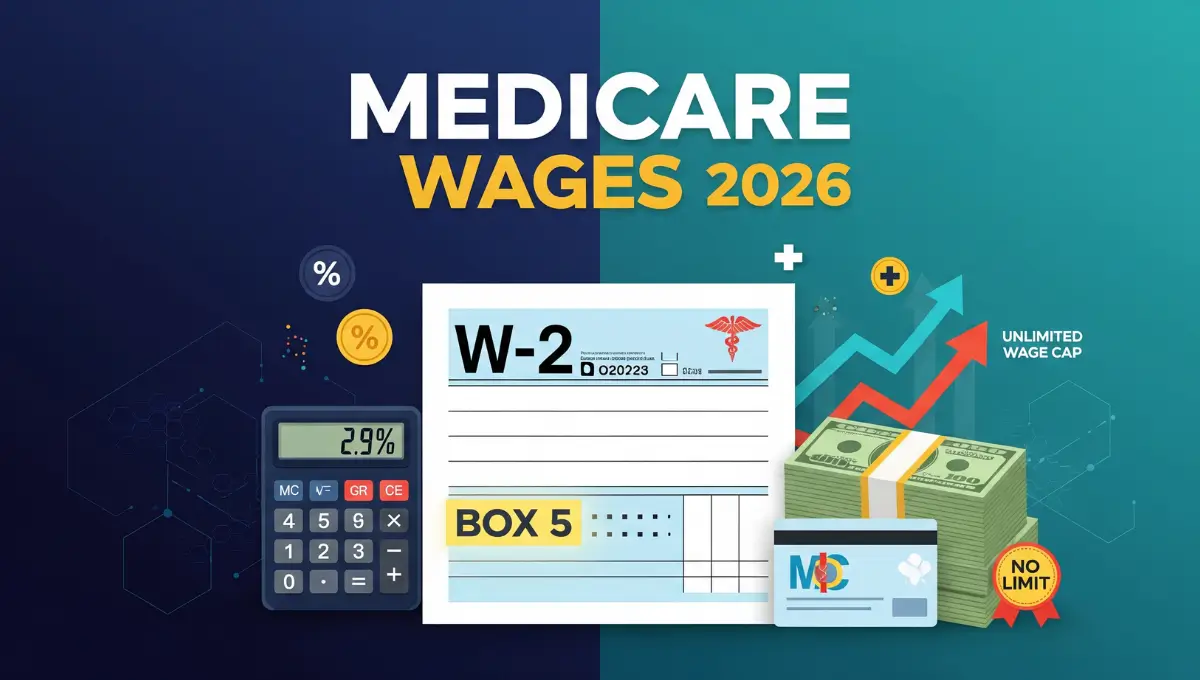

Medicare wages and tips are the earnings you pay Medicare tax on through FICA. In 2026, there is no wage cap—every dollar you earn gets taxed to support Medicare Hospital Insurance.
Quick Summary:
- Standard Medicare tax is 2.9% total (split between you and your employer)
- High earners pay an extra 0.9% on income above certain limits
- Pre-tax 401(k) contributions still count as Medicare wages
- Box 5 on your W-2 shows your total Medicare wages
- Self-employed workers pay the full 2.9% themselves
What Are Medicare Wages and Tips?
Medicare wages and tips include most types of pay.
These earnings appear in Box 5 of your W-2 form.
What Counts as Medicare Wages
Your Medicare wages include:
- Regular pay: Salary, hourly wages, overtime
- Bonuses and commissions: All performance-based pay
- Tips: Cash tips of $20 or more per month
- Retirement contributions: 401(k) and 403(b) deferrals
- Fringe benefits: Company car use, life insurance over $50,000
Even money you don’t pay income tax on—like 401(k) contributions—still counts for Medicare tax.
2026 Medicare Tax Rates
Standard Rate
Both you and your employer pay 1.45% on all wages.
That’s a combined total of 2.9%.
There is no wage limit. All earnings are taxed.
Additional Medicare Tax
High earners pay an extra 0.9% on income above these limits:
| Filing Status | Income Threshold |
|---|---|
| Married Filing Jointly | $250,000 |
| Married Filing Separately | $125,000 |
| Single or Head of Household | $200,000 |
Important: Your employer only matches the 1.45% rate. They don’t match the 0.9% additional tax.
How Medicare Tax Works
For Employees
Your employer withholds 1.45% from every paycheck.
Once you earn over $200,000, they withhold an extra 0.9%.
This happens automatically when your wages hit that amount.
For Self-Employed Workers
You pay the full 2.9% yourself.
This is part of your Self-Employment (SE) tax.
You pay both the employer and employee portions.
Special Rules for 2026
Withholding Requirements
Employers must start withholding the 0.9% tax when your wages reach $200,000.
This applies even if you’re married and file jointly.
You may need to adjust if your combined household income is higher.
Household and Election Workers
New thresholds apply in 2026:
- Household workers: Medicare tax applies if paid $3,000 or more
- Election workers: Medicare tax applies if paid $2,500 or more
Qualified Tips Deduction
Under the One Big Beautiful Bill Act (P.L. 119-21), you can deduct up to $25,000 of tips from income tax starting in 2025.
But those tips still have Medicare tax.
The deduction only affects your income tax, not FICA taxes.
Understanding Your W-2
Box 5 vs. Box 1
Box 5 (Medicare wages) is often higher than Box 1 (taxable wages).
Here’s why:
Box 1 excludes pre-tax retirement contributions. Box 5 includes them.
Example:
You earn $60,000 and put $5,000 in your 401(k).
- Box 1: $55,000 (taxable income)
- Box 5: $60,000 (Medicare wages)
Your 401(k) money avoids income tax but not Medicare tax.
What High Earners Need to Know
Filing Responsibilities
If your household income crosses the threshold, you may owe more tax.
Example:
You earn $150,000. Your spouse earns $120,000.
Your combined income is $270,000—above the $250,000 limit.
Your employer only withheld based on your $150,000. You’ll owe the 0.9% tax on $20,000 when you file.
Avoiding Penalties
Consider making estimated tax payments if:
- Your combined income exceeds thresholds
- Your employer didn’t withhold enough
- You have self-employment income
This prevents underpayment penalties at tax time.
Quick Reference Table
| Item | 2026 Amount/Rate |
|---|---|
| Standard Medicare tax (employee) | 1.45% |
| Standard Medicare tax (employer) | 1.45% |
| Combined Medicare tax | 2.9% |
| Additional Medicare tax | 0.9% |
| Wage cap | None—unlimited |
| Withholding trigger | $200,000 |
Official Resources
For complete tax details, visit the IRS Topic No. 751 page on Social Security and Medicare withholding.
Review Publication 15 (Employer’s Tax Guide) for 2026 rates and requirements.
Last Updated: January, 2026
Take Action: Check Box 5 on your W-2 to confirm your Medicare wages. If you’re a high earner, review whether you need to make estimated tax payments. Consult a tax professional if your household income exceeds the thresholds listed above.